
Wild Colombia
Five ecosystems of the world's second most biodiverse country
Colombia is the only country on the planet where in two weeks you can walk through snow, páramo, cloud forest, savannah, rainforest, and beach. That is not a tourist description. It is a geographical anomaly with an explanation: three mountain ranges that divide the territory into radically different ecosystems, two oceans bordering it, and a position in the tropics that turns every gradient of altitude into a new world. And every ecosystem has its own people, with their own language, their own memory, and their own way of understanding the territory they inhabit.
The Andes: Chingaza and the frailejones
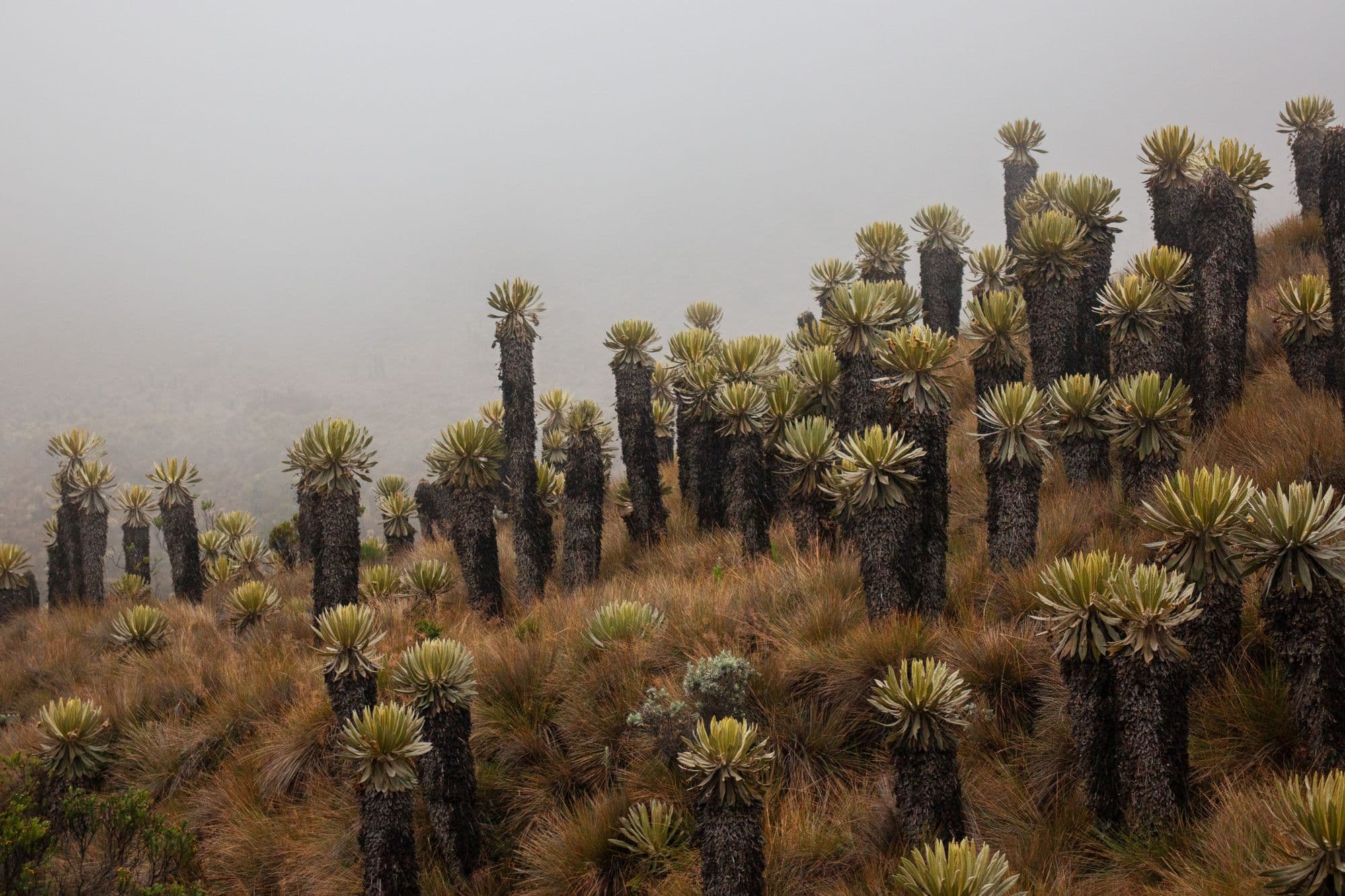
The journey begins in the Andes, in Chingaza, the páramo where millenary frailejones bloom in August and the glacial lagoons at four thousand metres feed the rivers of millions of people. Naturalist guides explain why Colombia has more bird species than Europe and North America combined. One hundred and fifty-seven species of hummingbirds live in private reserves in this region. At dawn, with the mist still between the trees, that becomes something difficult to process.
The Orinoquía: Caño Cristales and the joropo
The Orinoquía is another world. Caño Cristales blooms between July and November when the macarenia clavigera tints the riverbed red, yellow, green, blue, and black simultaneously, a phenomenon that occurs nowhere else on the planet. At Hato La Aurora, safaris are conducted on horseback among anacondas, caimans, and capybaras, with three hundred species of birds overhead and a llanero who narrates the territory through music, because the joropo is not folklore but sung geography.
The Amazon: black-water rivers and the Tikuna
In the Amazon, from Canaloa, the expedition navigates black-water rivers where pink dolphins surface without warning. The Tikuna indigenous communities teach a living pharmacopoeia — medicinal plants that science is only beginning to study, which that knowledge has been systematizing for centuries with a precision no laboratory has managed to replicate. The nocturnal canopy reveals a forest completely different from the daytime one, with sounds that have no name in any language other than that of those who always lived there.
The Pacific: whales and Afro-Colombian communities
The Colombian Pacific is the most biodiverse and least visited coast in the country. In Nuquí, between July and October, humpback whales arrive from Antarctica to give birth in warm waters, and encountering a mother and her calf from a small boat is one of those experiences that permanently reorders priorities. On land, the Afro-Colombian communities of Chocó have spent centuries living where the rainforest meets the ocean, building a culture of music, spirituality, and gastronomy as extraordinary as the animals that surround them.
The Sierra Nevada: guardians of the world
The journey closes at the Sierra Nevada de Santa Marta, the tallest coastal mountain range in the world, rising from sea level to over five thousand seven hundred metres in forty-two kilometres. There the Kogui and Arhuaco communities guard a worldview that has continued uninterrupted for more than two thousand years, where the health of the mountain and the health of the world are the same thing.
A conversation with an Arhuaco mamo is not an itinerary activity. It is access to a way of understanding the relationship between human beings and the territory that modernity has spent centuries trying to recover.
páramo · frailejones
forest in the mist
birds · biodiversity
See the full journey